
Vietnamese Fortune-Telling Traditions: Beliefs, Rituals, and Meaning
Vietnamese fortune-telling traditions offer a familiar way to think through uncertainty, from a new relationship or career choice to family plans and major life changes. Rather than treating every reading as a fixed prediction, many people use practices such as tử vi, or Vietnamese astrology, and xem ngày, choosing an auspicious date, as prompts for reflection, reassurance, or deciding when to act.
Customs may include palm reading, playing cards, poetry, or astrology calendars, but their meaning varies by region, family, and individual. For travelers curious about how belief fits into everyday life, Ho Chi Minh City tours can offer a closer view of local settings and customs. Approached with curiosity rather than certainty, these traditions reveal how people make space for hope when choices feel difficult.
Vietnamese Fortune-Telling Traditions: Meaning and Cultural Context
Vietnamese fortune-telling traditions are best understood as everyday ways of seeking perspective, reassurance, or a little luck, rather than as one fixed religious system. The broad practice known as xem bói can involve a reading, a calendar, or advice shared around a family occasion.
What happens depends on the person and place. A visitor might see someone consult a fortune-teller near a temple before Lunar New Year, while relatives at home discuss an auspicious date for a wedding or a new business. These customs often sit alongside Buddhist, Taoist, folk, and ancestor-veneration practices, though beliefs vary widely between families and regions.
How to read the cultural context
- Family custom: Advice may be sought for milestones such as marriage, travel, or moving house.
- Local belief: Methods and interpretations differ; a reading is not a single national rule.
- Personal meaning: Many people treat predictions as prompts for reflection, not certain outcomes.
For travelers, this distinction matters: observe respectfully, ask before photographing, and do not assume that everyone shares the same beliefs. A local guide can explain the setting and customs during a Ho Chi Minh City visit without presenting spiritual practices as attractions to consume.
In brief: Vietnamese fortune-telling is a varied set of everyday practices for interpreting uncertainty. Family traditions, regional customs, and religious influences shape how people use it, while individuals decide how much weight to give a reading.
| Context | Common purpose | What visitors should know |
|---|---|---|
| Family custom | Mark a life decision | Practices differ by household |
| Local or religious influence | Seek guidance or reassurance | Ask respectfully; avoid assumptions |
Approach a reading as a cultural encounter, not a guaranteed forecast. Explore local life with curiosity and respect, and choose a guided experience that helps you understand the context behind what you see.
How Vietnamese Fortune-Telling Traditions Work
Vietnamese fortune-telling traditions are varied, and a reading is not always a dramatic prediction of the future. For curious visitors, knowing the basic methods and etiquette makes an encounter easier to understand while keeping expectations realistic.
In brief: Common methods include tử vi, which interprets birth details; palmistry and face reading, which look at physical features; and xin xăm, in which a visitor draws a numbered fortune stick at a temple. A practitioner may explain the result as guidance, not a guaranteed outcome.
Common methods and what they focus on
| Method | What is considered | Typical setting | Visitor should know |
|---|---|---|---|
| Tử vi | Birth date and time | A consultation | Details may affect the reading |
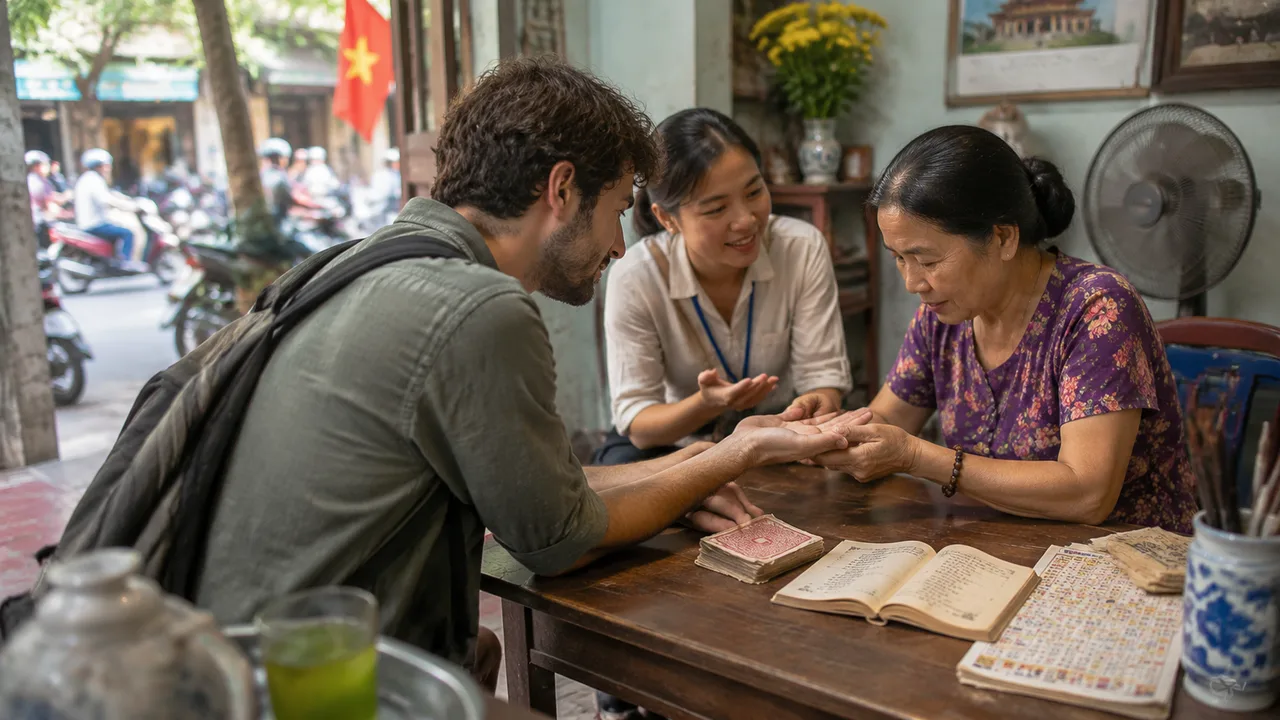
| Palm or face reading | Lines or facial features | A street-side stall or shop | Interpretations vary by reader |
| Xin xăm | A drawn fortune stick | A temple or pagoda | Ask how to interpret the result |
What happens during a consultation
A practitioner may first ask what you want guidance about. For tử vi, they may request your birth date and time; a palm reader may ask you to open one or both hands. At a temple, xin xăm usually involves drawing a stick and then asking someone to explain its written meaning. Customs differ, so observe first and ask permission before taking photos.
For example, a solo traveler curious about a career reading can share only the details they are comfortable giving and treat the answer as a cultural experience, not financial or medical advice. While exploring local neighborhoods, browse Toward Local experiences to plan a respectful visit alongside other local discoveries. Choose a reader with clear prices, avoid pressure to pay for extra rituals, and leave if anything feels uncomfortable. A thoughtful question and an open mind are better preparation than expecting a fixed prediction.
Why People Consult Fortune-Tellers in Vietnam
Quick answer: People consult fortune-tellers in Vietnam to seek reassurance or a second perspective during uncertain moments. Common occasions include choosing a wedding date, weighing a business decision, planning travel, and welcoming the Lunar New Year. For many, a reading is cultural guidance, not a fixed instruction about what must happen.
Important dates and decisions
Families may ask about a wedding date, while business owners might look for an auspicious time to open a shop. Before a long trip, some people seek reassurance; around Tết, a yearly reading can offer a way to think about hopes and worries. Practices and beliefs vary, so not every Vietnamese person consults a fortune-teller.
For visitors exploring local neighborhoods, pairing cultural stops with a local Ho Chi Minh City tour can help put everyday customs in context.
| Occasion | Common question | What the reading may offer |
|---|---|---|
| Marriage | When to hold the ceremony | Family reassurance |
| Business | When to begin | A prompt to reflect |
| Travel or Tết | What the coming period may bring | Comfort amid uncertainty |
Guidance shared with family and community
A reading can create space to discuss a concern with relatives, especially when a decision affects the whole household. The useful insight is often less about predicting a precise outcome and more about feeling heard, considering options, or finding the confidence to act. Treat predictions as cultural perspectives rather than substitutes for practical advice on health, money, or safety.
Curious travelers can observe respectfully, ask before photographing, and let local hosts explain what a practice means to them. Choose an experience that makes room for genuine neighborhood context, not staged certainty.
How Fortune-Telling Differs From Astrology and Religious Practice
Vietnamese fortune-telling traditions can look similar to astrology or worship, but they serve different purposes. Knowing the distinction helps visitors explore a local shrine or consult a reader respectfully, without treating every spiritual practice as a prediction.
In brief, fortune-telling interprets signs to offer personal guidance; astrology uses birth details and celestial or calendrical systems to describe patterns; religious practice centers on devotion, community, and ritual. The boundaries can overlap, and meanings vary by family and region.
Comparing tử vi with Western astrology and other divination
Vietnamese tử vi commonly draws on birth year, lunar calendar calculations, and related cosmological ideas to interpret a person’s life. Western astrology typically emphasizes a birth chart based on planetary positions. Palm or card readings, by contrast, interpret lines or symbols in a particular session.
For example, a visitor might receive a general yearly reading at a pagoda during Lunar New Year, while a Western astrologer may examine a detailed natal chart. Neither method is the same as a spontaneous palm reading.
A quick distinction: fortune-telling offers an interpretation of signs; astrology organizes interpretations around birth and celestial cycles; divination can include many methods, including cards, poetry, or palms.
| Practice | Main focus | Common example |
|---|---|---|
| Fortune-telling | Guidance from signs | Palm or card reading |
| Astrology | Birth and celestial patterns | Tử vi or natal chart |
| Religious practice | Devotion and ritual | Prayer or offerings |
Distinguishing readings from worship and mediumship
Ancestor veneration honors deceased family members through remembrance, offerings, and care for a household altar; it is not automatically a request to predict the future. Buddhist worship may involve prayer, offerings, or seeking peace, while spiritual mediumship involves a practitioner understood by participants to communicate with spirits. These practices are not interchangeable, and not every Vietnamese person follows them in the same way.
When exploring local customs, observe quietly and ask before photographing people or ritual objects. A Hoi An local culture tour can provide context for everyday customs, but a reading is personal and should never be treated as a guaranteed forecast. Join a guided local experience to learn with respect, and let practitioners set the boundaries.
Responsible Ways to Explore Vietnamese Fortune-Telling Traditions
Vietnamese fortune-telling traditions can offer a glimpse into everyday culture, but visitors may wonder how to take part without treating belief as a tourist spectacle. The most respectful approach is to stay curious, ask before observing, and remember that people relate to these practices in different ways.
A reading may be a personal ritual, light entertainment, or a source of reassurance. Treat predictions as cultural interpretation, not proven guidance for health, money, relationships, or safety. If you are exploring with a local guide, choose small-group Hoi An walks that leave room for questions without promising access to private ceremonies.
A respectful visitor’s checklist
- Ask permission before photographing a reader, client, altar, or ritual.
- Agree on the price and expected length before a paid reading; leave if pressured to buy extra services.
- Keep personal boundaries. You can decline questions or stop at any time.
- Do not assume every Vietnamese person believes in fortune-telling or follows the same customs.
In brief: Fortune-telling is present in Vietnamese life, but belief varies widely. A reading is optional, not a measure of cultural knowledge. Approach it as an invitation to learn, protect your privacy, and never use predictions as a substitute for professional advice.
Common questions
Is fortune-telling common in Vietnam? It is familiar in some communities and around certain occasions, but participation varies by person, family, and region.
Is tử vi the same as astrology? Not exactly. The term often refers to a traditional system using birth details and calendrical ideas; it is not identical to Western astrology.
Do all Vietnamese people believe in it? No. Some consult readers, some treat it as entertainment, and others do not believe in it.
Can visitors receive a reading? Often, if a practitioner welcomes visitors and explains the fee. Ask first, respect a no, and avoid sharing sensitive information.
| Situation | Good practice | Set a boundary | Why it matters |
|---|---|---|---|
| Watching a reading | Ask everyone first | Put the camera away | Protects privacy |
| Booking a session | Confirm price upfront | Decline added services | Keeps consent clear |
If the conversation sparks your interest, explore local culture with an open mind and choose a thoughtful local tour. Let curiosity guide the experience, not a prediction.